Updates on the Dual-Use Project
Project title: Research and Development of Unmanned Platforms and an Innovative Antenna Radiation Pattern Measurement and Analysis System
Project No.: 1.2.1.1/3/25/A/011
Significant progress has been achieved under Activity D1, “Development of a New Methodology for 3D Radiation Pattern Measurements on Unmanned Platforms,” and the majority of the planned work has been completed.
The procurement of the measurement equipment planned within the project has been completed.
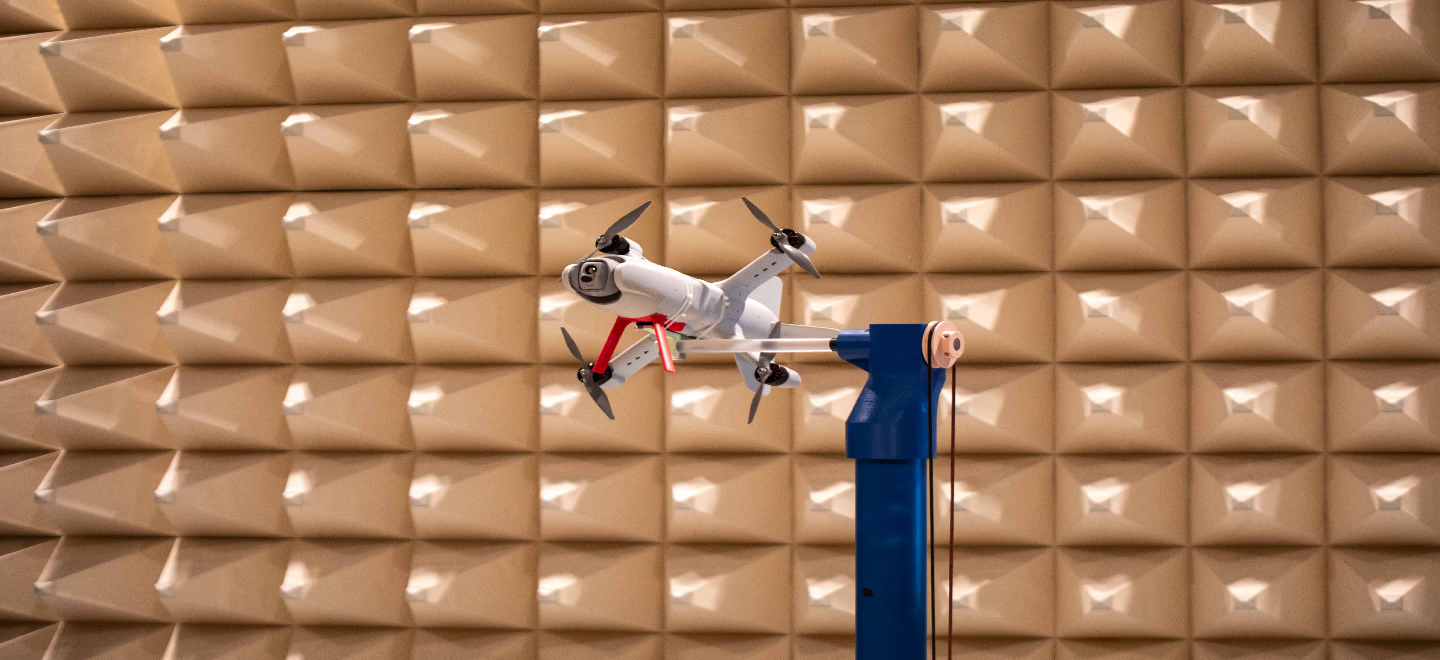
In cooperation with Riga Technical University (RTU), the development of the measurement methodology has been completed. The methodology is intended for measuring three-dimensional antenna radiation patterns under controlled conditions using a shielded anechoic chamber, thereby ensuring high measurement accuracy and repeatability. Measurements are performed using a spherical measurement system, with the unmanned platform and its antenna rotated in two planes.
The methodology has been successfully validated on multiple occasions by comparing the obtained measurement results with results produced by calibration laboratories in Germany. Two complementary verification methods were also used: a comparison of the Friis free-space method with the substitution method, and a comparison of horizontal and vertical polarization.
Measurements were performed over a frequency range from 300 MHz to 18 GHz using various antenna configurations, including HF906, HF907, HL562E and CLSA0110. The statistical summary indicators confirm the reliability of the method: the mean absolute deviation between the polarizations is 0.40 dB, the difference between the Friis and substitution methods remains within 1 dB, and the average deviation from the calibration data does not exceed 0.93 dB.
In addition, based on the validation data, an optimized measurement algorithm has been developed for predefined antenna types. The algorithm reduces measurement error and improves repeatability. A detailed report has also been prepared, covering all measurements performed, the experimental work and the analysis.
During the development of the methodology, electromagnetically transparent materials for the positioning-system structures were also evaluated in order to minimize their influence on the measurement results. The influence of absorbing materials on the measurement results was analysed as well.
A measurement algorithm has been developed to ensure an accurate and reproducible measurement process. It enables measurements to be performed both on individual antennas and on antennas integrated into unmanned platforms. The methodology also provides for measurements under dynamic operating conditions.
As part of the methodology, guidelines and measurement scripts were developed for automated measurement execution, data acquisition, data processing and the generation of three-dimensional radiation patterns. These results provide the basis for the implementation of the project’s subsequent activities.